
Meet the Los Angeles Chargers 2026 Draft Class and Trade Analysis

Heading into the 2026 NFL draft, the Chargers only had 5 total picks in rounds 1, 2, 3, 4, and 6. They needed to find a potential starting offensive guard to compete with current projected starter, Trevor Penning. They needed to find a rotational pass rusher for this year, and a future long-term replacement for Khalil Mack. They needed to build out the depth of the offensive line, and unearth longterm stability across all five positions. Those were the main priorities, and with only 5 picks, General Manager Joe Hortiz had to find a way to navigate the draft with filling positions of need, all while trading back and accumulating more picks. In the end, it was another masterclass of a draft.
How did Joe Hortiz do with trades?

Trade # 1 down with New England Patriots
Send (350 in trade value)
2nd Rd/Pick 55 to NE (350) DE Gabe Jacas
Receive (328 in trade value)
2nd Rd/Pick 63 (276) OG Jake Slaughter
4th Rd/Pick 131 (41) S Genesis Smith
6th Rd/Pick 202 (11) OG Logan Taylor
Trade # 2 down with Cleveland Browns
Send (160 in trade value)
3rd Rd/Pick 86 to CLE (160) OT Austin Barber
Receive (126 in trade value)
4th Rd/Pick 105 (84) WR Brenen Thompson
5th Rd/Pick 145 (33.5) DT Nick Barrett
6th Rd/Pick 206 (8.6) OG Alex Harkey
Trade # 3 up with Houston Texans
Send (58.4 in trade value)
4th Rd/Pick 123 to HOU (49) LB Wade Woods’s
6th Rd/Pick 204 to HOU (9.4) WR Lewis Bond
Receive (60 in trade value)
4th Rd/Pick 117 (60) OT Travis Burke
NFL Teams use a trade value chart, created in the 1990’s by a former Cowboys executive, Mike McCoy, and made popular by Hall of Fame coach Jimmy Johnson. It has been the standard in the industry regarding movement of draft picks. Technically, the Chargers lost two trades and broke even with another. They sent a total of 568 points away in trade value, and received back 514 points. Still, they turned 5 original trade picks into 9 players drafted.
Joe Hortiz was always going to find a way to accumulate more draft picks, and while they could have chosen to trade out of the first round, they stayed put, chose to trade back 8 picks in the 2nd round, and out of the 3rd entirely. This likely meant that they believed in a bulk of late mid round players who had a legitiment path to making the 53 man roster out of training camp.
Round 1, No. 22 overall: Akheem Mesidor, Edge, Miami

Akheem Mesidor was Dane Brugler’s 5th-ranked edge rusher in this class, and projected as a late first round pick. At 6’3, 260 pounds, Mesidor has the athletic profile to line up as a true speed rusher, and the build to hold up effectively as an edge setter for the Chargers. Originally a 3-star recruit, Misodor started his career at West Virginia where he spent his first two seasons with the Mountaineers, accumulating 14.5 tackles for loss, and 9.5 sacks. He transferred to Miami to search for further development opportunities, ultimately being coached by Hall of Fame Defensive End Jason Taylor.
Under Jason Taylor’s tutelage, Mesidor continued to develop as a pass rusher where he was no stranger to being disruptive in the backfield. From 2022 to 2025, he accumulated 38 tackles for loss and 26 sacks, and he only played in 2 games in 2023. His 6th-year season in particular was instrumental in the Hurricanes making the College Football Championship game, where he accounted for 17.5 tackles for loss, 12.5 sacks, and 4 forced fumbles.
Mesidor is an older prospect at 25 years old, but he is the heir apparent to Khalil Mack and he is already fully developed physically to become an impact player for the Chargers defense. He is explosive to beat tackles to the edge, has the power to bull rush lineman into the pocket, and he has played enough football across 6 college football seasons to have the knowledge of a more veteran player. He has some injuries across his collegiate career, and he leaves his feet too often when chasing ball carriers, but getting Mesidor on a rookie contract through most of his prime years can be one a major advantage to the Chargers.
Fun fact: Misodor grew up in Canada, speaks both English and French, and he owns 2 French Bulldogs.
Round 2, No. 63 overall: Jake Slaughter, C, Florida

Each member of the coaching and scouting staff get a blue star that they attach to a single prospect. It signifies a draft prospect that the coach/scouting staff is banging on the table for. It’s doesn’t have to be the best player, but the one player each scout believes embodies what it means to be a Charger. Joe Hortiz used his blue star on Jake Slaughter, a center prospect who they believe can make the transition to guard and potentially become the center of the future after Tyler Biadasz.
What was it that Hortiz saw in Dane Brugler’s top center prospect, Jake Slaughter? Maybe it was the athleticism to fit in Mike McDaniel’s scheme, considering he scored a 9.97 RAS score with a height of 6’5”, weight of 303 pounds, running a 5.10 40-yard-dash, vertical of 32.5 inches, and a broad jump over 9.0 feet. Maybe he saw a player who could be an asset for his ability to finish blocks through the whistle, has understanding of leverage, footwork, and the centers view of identifying rushers and calling out fronts.
Slaughter is a well matured (Team Captain/3x SEC Academic Honor Roll), hard working offensive lineman who gives the Chargers flexibility up front. The Chargers called him a guard on draft weekend, so they see a player who could win a competition at Left Guard, but they also get a starting caliber center if Biadasz succumbs to injury. At worst, he provides the Chargers depth at any interior spot.
Round 4, No. 105 overall: Brenen Thompson, WR, Mississippi State

If a Blue Star was awarded to WR Brenen Thompson, you’d have to imagine that offensive coordinator Mike McDaniel had the fastest player in the draft assigned for his pick. While undersized at 5’9” and 164 pounds, Thompson brings Olympic level speed to the Chargers. Only four players in the history of the NFL Combine have ever recorded a faster time: 4.21 WR Xavier Worthy (2024), 4.22 WR John Ross (2022), 4.23 CB Kalon Barnes and 4.24 RB Chris Johnson (2008). Speed does not always translate to instant success, but it creates a dynamic wrinkle in an offense that stresses defenses both vertically and horizontally. No playcaller is as adept in utilizing speed the way that Mike McDaniel has done with players like Tyreek Hill, Jaylen Waddle, and Devon Achane.
Thompson won a state Championship in the 100 (10.24) and 200 (20.73) meter dash in highschool. He committed to the Texas Longhorns after a 4.20 GPA. Following his freshman season, he transferred to Oklahoma to be closer to his hometown in North Texas and being only one of two players to play on both sides of the Red River Rivalry. He was used only sparingly by Texas and Oklahoma, and later followed his offensive coordinator to Mississippi State where he enjoyed a breakout season that led to 57 catches for 1,054 yards (18.5avg), and 6 scores.
Due to his underwhelming size, Thompson may have injury concerns, but he is a drag race specialist who can turn small creases into 90-yard touchdowns. There is potential that he can be a dangerous return man, but he was not utilized much in that role in college. He played primarily outside (88%) for Mississippi state. Most of what Brenen Thompson provides are projections of what could be. He is a deep specialist who will take the top off defenses, but there are more questions on what Thompson will provide outside of given straight line speed.
Round 4, No. 117 overall: Travis Burke, OT, Memphis

RT Joe Alt was the tallest player in the Chargers. That was before Travis Burke was drafted by the Chargers second pick in the 4th round. Burke stands 6’9” and carries 325 pounds as one of the most physically imposing blockers in the draft. That includes 34 1/4 arms and 10 1/8” hands, showing off his incredible length. He projects as the Chargers future swing tackle behind RT Joe Alt and LT Rashawn Slater.
Burke started his career at FCS level Gardner-Webb, redshirting as a Freshman and finishing the following season with 8 starts at left tackle and 5 starts at right tackle. Looking for increased competition, he transferred to Florida International University for two seasons, starting every game at left tackle. With his 5th year of eligibility, he transferred to Memphis flipping back to right tackle. As a swing tackle, Burke played a lot of snaps on both sides of the offensive line.
Burke has a mean mentality as a blocker, and he towers over opponents. Even at his gargantuan size, Burke showed off better athleticism than most other prospects to climb levels in the run game. He will struggle to maintain leverage at his height, and stay low on blocks to really open rushing lanes consistently, but he has length many teams look for off the edges, with a long kickstep to mirror speed rushers off the edge.
Round 4, No. 131 overall: Genesis Smith, S, Arizona

Genesis Smith was Dane Brugler’s 9th-ranked safety and was graded as a 4th round prospect. In response to his grandmother passing away from COVID-19, Smith created the Genesis Smith Foundation, which is dedicated to serving families in need and continues to honor her memory and ensure her vision of kindness and community support lived on.
He attended Hamilton High School in Arizona that produced QB Tyler Shough and LB Terrell Suggs. As a 3-star recruit, Smith chose to attend Arizona over offers from Washington, Arizona State, and Oregon State. Smith finished his collegiate career with 164 tackles, 6.5 tackles for loss, 14 PBU’s, 4 forced fumbles and 5 interceptions across 3 years.
In coverage, Smith provides range to cover sideline to sideline and does his best work as a single high safety. He’s instinctive and covers a lot of ground quickly to make plays in the deep part of the field. He’s instinctive in coverage. The weak part of his game is as a willing but inconsistent tackler. According to the coaching staff, it’s an issue they believe they can clean up with technique. They raved about his character and believe that Smith can come out as a rotational piece when 3 safties are present on the field.
Round 5, No. 145 overall: Nick Barrett, DT, South Carolina

Another blue star was awarded to Defensive Tackle Nick Barrett, presumably by the Chargers longtime Southeastern scout, Donovan Beidelschies. If there was a game that put Barrett on the Chargers radar, it was a South Carolina’s Week-12 matchup against Texas A&M the pitted Barrett against 2nd round Guard Chase Bisonitis. It wasn’t a big game statistically for Barrett, but he consistently gave Bisonitis fits all game, and helped the 3-7 Gamecocks humble a 9-0 Texas A&M team. Texas A&M found themselves down 30-3 at halftime, but managed a 28 point comeback to eventually get themselves into the college football playoff.
Barrett was a 4x SEC Honor Roll student at South Carolina, team captain, and didn’t have his big breakout year until his 5th year in college. He combined for 42 tackles, 6 tackles for loss, and 2 sacks, while also rumbling for a 17-yard scoop and score touchdown. At 6’3/312 pounds, Barrett brings length, and thick lower half that bruises blockers in front of him with strength. There is some concern with only being a one year starter in college, and he is under developed as a pass rusher, but Barrett is a stout run defender who did the dirty work lined up over the center and taking on double teams.
Round 6, No. 202 overall: Logan Taylor, OG, Boston College
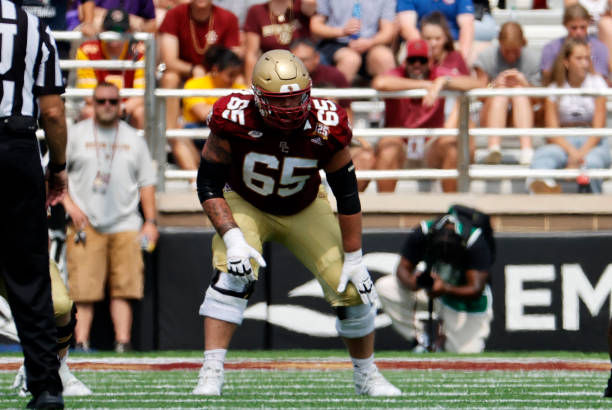
Logan Taylor is another lengthy (6’7”/ 314 pounds) offensive lineman from Nova Scotia, Canada who has experience across all spots on the offensive line except center. In 2022, he started 9 games at LT, and 1 at RT for Virginia as a true sophomore. He transferred to Boston College as a Junior and started every game at Left Tackle. In 2024, he moved to LG and started every game there, then moved around as a 5th-year senior logging 8 games at RG, 3 games at LT, and 1 game at RT. That type of flexibility makes Taylor one of the most versatile offensive lineman in this class, earning a 4th-round grade by Dane Brugler.
Taylor joins an already crowded guard room that includes projected starters LG Jake Slaughter and RG Cole Stange, and depth players that includes 2022 1st round pick Trevor Penning, 2021 3rd round pick Ben Cleveland, Free Agent addition Kayode Awosika, 2025th 6th round pick Branson Taylor, and this years other 6th round pick Alex Harkey. Taylors path to the roster will be his position versatility, but he’s probably just as likely to head to the Chargers practice squad for further development.
Round 6, No. 206 overall: Alex Harkey, OG, Oregon

Alex Harkey was Dane Brugler’s 13th ranked guard, given 5th round grade, and drafted four spots below Logan Taylor. He will also compete with all those other names mentioned for a roster spot, but may also find his way to the practice squad. He helped Oregon reach the college football playoff. Harkey played defensive line and tight end in high school, but was an unranked recruit without the academics to earn a scholarship in grade school. He went the junior college route at at Tyler Junior College in Texas for two seasons and earned a spot on the Colorado football team as a junior. He transferred to Texas State for two seasons before landing at Oregon for his 6th year of eligibility.
Harkey has a boxy frame with nimble feet and plays aggressively in the run game. He takes proper angles in zone blocking scheme runs and he has solid controlled strikes in pass protection. NFL Scout said “coaches at Oregon challenged him and he responded well and was overall a positive add” for a championship level team. Harkey has short arms, doesn’t play with strength through his lower half and plays with a top heavy, elevated pad level.
Honorable Mention: Undrafted Free Agent OT Isaiah World, Oregon

One of the top adds came after the draft, with Oregon’s LT Isaiah World. World is a San Diego native who played 4 years for the Nevada Wolfpack, and transferred to Oregon for his 5th-year season. Going undrafted was more of an injury issue than ability, as World tore his ACL in January against Indiana in the college football playoff. He is a technically raw prospect, but he’s played in a career high of 51 total games. But at 6’5”, 325 pounds, and 34 1/2” arms, there are characteristics about Worlds game worth developing that make him an enticing practice squad stash and future backup in the league. He is physically imposing, mobile as a big man, and has experience on both sides of the offensive line. Oregon opened up the checkbook to add him as their starter, and had World not had the late season injury, he likely would have been a day-2 pick.


Comments